Key Takeaways
- A whistleblower report delivered to Congress in November 2024 alleges a secret Pentagon programme called 'Immaculate Constellation' has been collecting high-resolution UAP data since 2017.
- The programme allegedly holds thousands of images and videos far clearer than anything ever released to the public — described as 'not those fuzzy photos'.
- The Department of Defense officially denies the programme exists, stating it has 'no record, present or historical' of any SAP called Immaculate Constellation.
- The March 2026 Capitol Hill hearing on UAP transparency featured testimony linking the programme to a wider, decades-long 'secretive arms race' involving recovered UAP technology.
- With Trump's UAP disclosure order still to produce any actual files, Immaculate Constellation has become the focal point of calls for urgent congressional oversight.
📑 Table of Contents
What Is Immaculate Constellation?
It sounds like the title of a spy thriller. But according to a whistleblower report delivered directly to the United States Congress, "Immaculate Constellation" is the codename for a real, highly classified Pentagon programme — one that has allegedly been collecting, cataloguing, and concealing extraordinary UAP evidence for nearly a decade.
The claim is this: while the public has been shown grainy, low-resolution footage of unidentified objects — the famous "tic-tac" video, the "gimbal" clip, a handful of declassified AARO images — the United States government has been sitting on something far more significant. Thousands of high-resolution images and videos, captured by military satellites, drones, and sensors, showing UAPs in sharp, unambiguous detail. Material that, according to sources cited in the whistleblower report, is "not those fuzzy photos and videos that we've been given."
If true, it would represent the most consequential revelation in the history of UAP research. If false, it is the most elaborate deception yet. Either way, the story has now reached the floor of Congress — and it refuses to go away.
The Whistleblower Report
The story traces back to November 2024, when independent journalist and author Michael Shellenberger introduced a 12-page document at a House Oversight Committee hearing — a report attributed to an anonymous whistleblower with claimed direct knowledge of the programme.
According to the document, the Department of Defense created Immaculate Constellation in 2017. The timing is significant: that was the year a landmark New York Times investigation blew open the existence of the Advanced Aerospace Threat Identification Program (AATIP), the Pentagon's previous secret UAP research effort. The whistleblower alleges that in response to that public exposure, the DoD essentially went further underground — establishing a new, even more tightly controlled Unacknowledged Special Access Program (USAP) to continue collecting UAP data away from congressional oversight.
USAPs are the most secretive classification tier in the US government. Unlike standard SAPs — which are at least acknowledged to Congress through appropriate oversight committees — Unacknowledged SAPs are programmes whose very existence is denied. Members of Congress with even the highest security clearances can be legally stonewalled when asking about them. This, critics argue, is precisely the mechanism that has allowed UAP-related programmes to operate in the dark for decades.
The report was submitted to Congress by Congressman Nancy Mace, a Republican from South Carolina and an increasingly prominent voice in UAP transparency efforts.
The March 2026 Capitol Hill Hearing
The story reached a new crescendo in March 2026 when the House Oversight Committee convened a joint subcommittee hearing formally titled "Unidentified Anomalous Phenomena: Exposing the Truth."
The hearing brought together former military personnel, intelligence officials, and researchers. Shellenberger testified again, referencing updated claims about Immaculate Constellation. Also present were witnesses who testified — under oath — that the United States has been engaged in what they described as a "secretive arms race" involving the study and reverse-engineering of recovered UAP technology. This goes well beyond mere surveillance. The implication is that recovered non-human craft have been acquired, studied, and that efforts to understand their propulsion and materials have been ongoing for decades.
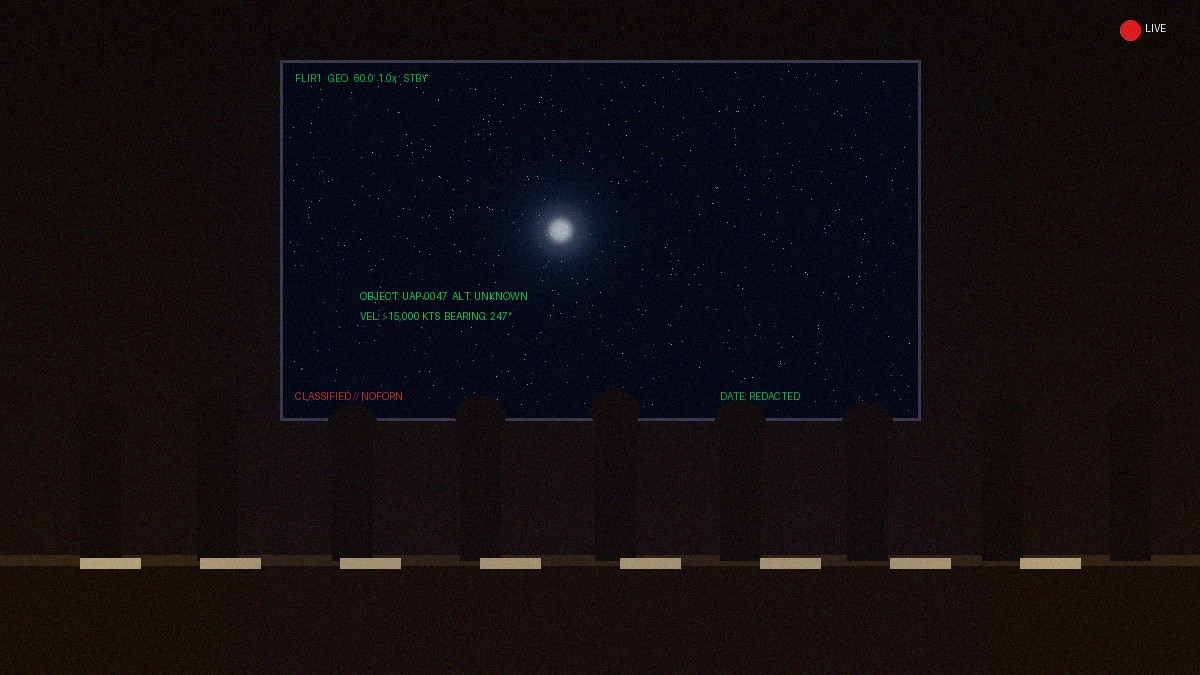
The hearing was notable for its tone. Previous UAP hearings had often been met with polite scepticism from lawmakers. This time, members from both parties pressed witnesses hard for specifics — suggesting that at least some members of Congress believe the underlying claims merit serious investigation, regardless of what the Pentagon says publicly.
What the Programme Allegedly Holds
Based on the whistleblower report and supporting testimony, here is what Immaculate Constellation is alleged to contain:
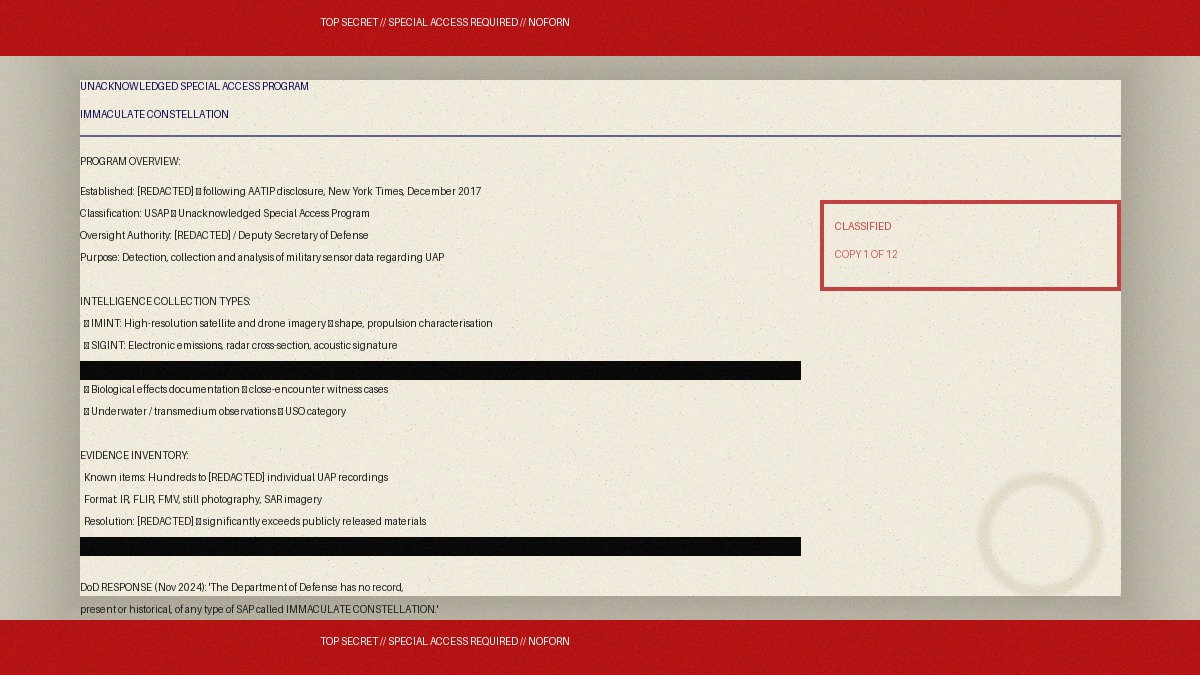
High-resolution imagery. The centrepiece claim. Sources describe a vast library of UAP images and video captured using military-grade satellite and drone systems — infrared, forward-looking infrared (FLIR), full motion video (FMV), still photography, and synthetic aperture radar (SAR) imagery. Crucially, witnesses state this material clearly shows object shape, surface characteristics, and apparent propulsion signatures. It is, they say, incomparably clearer than anything in the public domain.
Acoustic and electronic intelligence. Beyond imagery, the programme allegedly includes SIGINT data — electronic emissions, radar cross-sections, and acoustic signatures from UAP encounters. This kind of data could, in theory, help characterise what these objects are made of and how they operate.
Underwater and transmedium observations. The programme reportedly extends beyond aerial UAP to include Unidentified Submersible Objects (USOs) — craft observed moving between air and water without apparent difficulty. The transmedium behaviour of UAPs has been a recurring feature of credible military sightings for years.
Biological effects documentation. Perhaps the most striking claim: the whistleblower report alleges the programme includes records of biological effects on military personnel who encountered UAPs at close range. This echoes testimony from the 2023 hearings, where former intelligence officer David Grusch described injured witnesses and claimed knowledge of non-human biological material recovered at crash sites.
The Pentagon's Response
The Department of Defense has been unambiguous, if brief. In an official statement, DoD spokesperson Sue Gough said: "The Department of Defense has no record, present or historical, of any type of SAP called 'Immaculate Constellation.'"
This is, on its face, exactly what the DoD would say about an Unacknowledged Special Access Programme. That is the point of a USAP — plausible deniability is a feature, not a bug. Whether the denial is technically accurate (the programme exists under a different codename), entirely truthful (no such programme exists), or deliberately misleading is impossible to determine from the outside.
What is notable is what the DoD did not say. It did not claim no UAP programmes of this type exist. It denied only this specific name. That distinction has not been lost on researchers and congressional staff watching closely.
The All-domain Anomaly Resolution Office (AARO) — the Pentagon's official UAP investigation body — also has no apparent knowledge of the programme. As of early 2026, AARO's public-facing case database stands at over 2,400 entries, with 171 remaining officially unexplained. But AARO itself has faced criticism for being deliberately kept out of the loop on legacy programmes — a charge its own former director, Dr. Sean Kirkpatrick, appeared to validate when he resigned in 2023 citing what he described as obstruction from elements within the defence and intelligence establishment.
Why This Matters — And Why Now
It is easy, given the history of UAP disclosure, to become jaded. Bombshell hearings come and go. Promises of document releases quietly expire. Whistleblowers surface, are discredited or ignored, and fade from the news cycle.
But several things make the Immaculate Constellation story different in degree, if not in kind.
First, the programme was named in a formal document delivered to Congress. This is not a social media post or a late-night radio claim. Whatever its ultimate credibility, the report exists as a congressional submission. That creates a paper trail, oversight obligations, and — potentially — legal exposure for those who deny or obstruct.
Second, the timing aligns with unprecedented political pressure. President Trump's executive directive calling for UAP files to be identified and prepared for release remains formally in force. The directive has so far produced no publicly released documents, but it did signal — at the highest level of the executive branch — that UAP transparency is now a stated policy goal. Immaculate Constellation is exactly the kind of programme that directive, if enforced, should surface.
Third, the convergence of voices is significant. Former senior intelligence and military officials are no longer testifying to fuzzy objects and unusual flight characteristics. They are now testifying — under oath — to secret programmes, recovered materials, and a systemic effort to conceal information from Congress. The credibility of individual witnesses can be questioned. The cumulative weight of this testimony is harder to dismiss.
What Happens Next?
Congress now faces a choice. The UAP Disclosure Act, portions of which were passed and then gutted in 2024, is back in play. A new version — the UAP Transparency Act (H.R.1187) — is being pushed in the 119th Congress, with provisions that would compel the executive branch to transfer UAP-related materials and programmes to an independent review board with genuine access authority.
Whether it passes, and whether any president will enforce it against a deeply entrenched classification apparatus, remains to be seen.
What is clear is that the days of UAP disclosure being a fringe concern are long gone. Immaculate Constellation — real or misnamed, confirmed or fabricated — is now a matter of official congressional record. The question is no longer whether the government knows more than it has told us. Almost everyone who has looked closely at this issue concludes that it does.
The question is whether, this time, anyone with the power to act will actually force the vault open.
Have a thought on Immaculate Constellation or the wider disclosure picture? The comments are open below.