Key Takeaways
- JWST has confirmed L 98-59 d is a 'sulphurous magma ocean world' — the first of a new class of exoplanet
- The entire surface is a permanent ocean of molten rock thousands of kilometres deep
- An atmosphere of hydrogen sulphide and sulphur dioxide keeps the magma from cooling — it literally smells like rotten eggs
- The planet is a super-Earth orbiting a red dwarf star just 35 light-years away
- The discovery, published in Nature Astronomy on 16 March 2026, was led by Dr Harrison Nicholls at the University of Oxford
📑 Table of Contents
A World That Shouldn't Exist
Imagine a planet where it has never been cold. Not just warm — but permanently, entirely molten. No solid ground anywhere. A global ocean of churning, glowing rock stretching down for thousands of kilometres, wrapped in an atmosphere that smells, if you could somehow stand in it, like rotten eggs.
That world is real. It orbits a dim red star 35 light-years away. And on 16 March 2026, a team led by Dr Harrison Nicholls at the University of Oxford published the evidence in Nature Astronomy — confirming that the James Webb Space Telescope has identified the first member of an entirely new class of planet.
They are calling it a sulphurous magma ocean world. And it changes what we thought we knew about how rocky planets evolve.
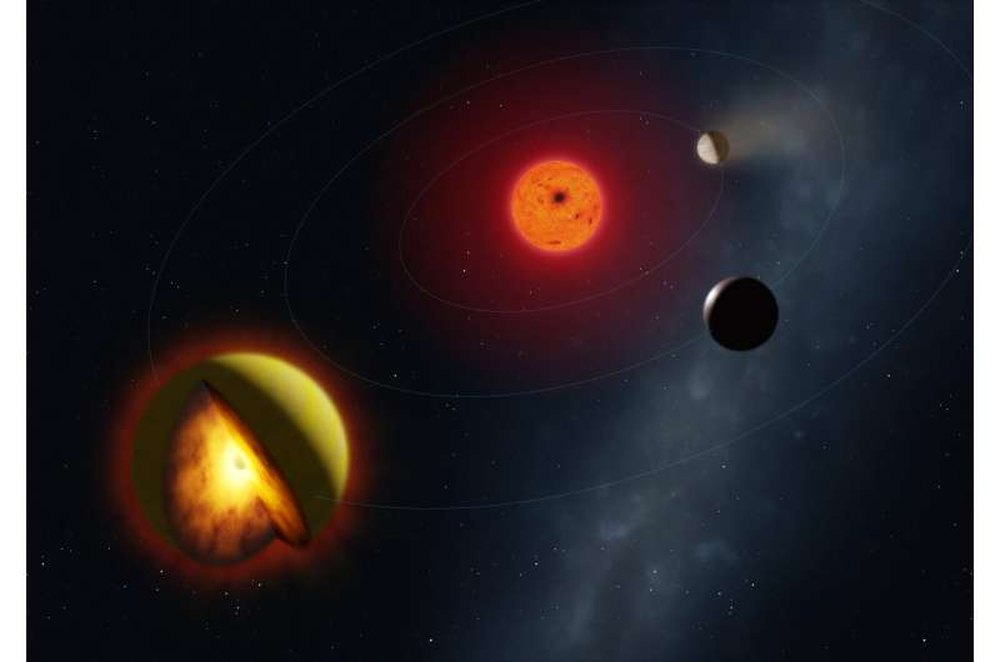
Artist's impression of L 98-59 d's surface. The entire planet is covered by a permanent ocean of molten silicate rock. Credit: Mark A. Garlick / University of Warwick.
Meet L 98-59 d
The planet in question is L 98-59 d, the third planet orbiting the star L 98-59 — a small, cool M-type red dwarf star in the constellation Volans (the Flying Fish), sitting just 35 light-years from Earth. L 98-59 d was first discovered in 2019 using NASA's TESS space telescope, which detected the tiny dimming of starlight as the planet crossed its star's face.
The numbers tell you immediately that this is no ordinary world:
- Mass: 1.64 times Earth's mass (a super-Earth)
- Radius: 1.627 times Earth's radius
- Orbital period: 7.5 days — an entire "year" in less than two weeks
- Distance from star: Extremely close — far inside the habitable zone
- Surface temperature: Thousands of degrees Celsius
That orbital period is the key to everything. L 98-59 d races around its star so fast that it receives an enormous amount of radiation and heat. Models had predicted that a planet this close would quickly lose its atmosphere, leaving a bare, baked rock. What JWST found was far stranger.
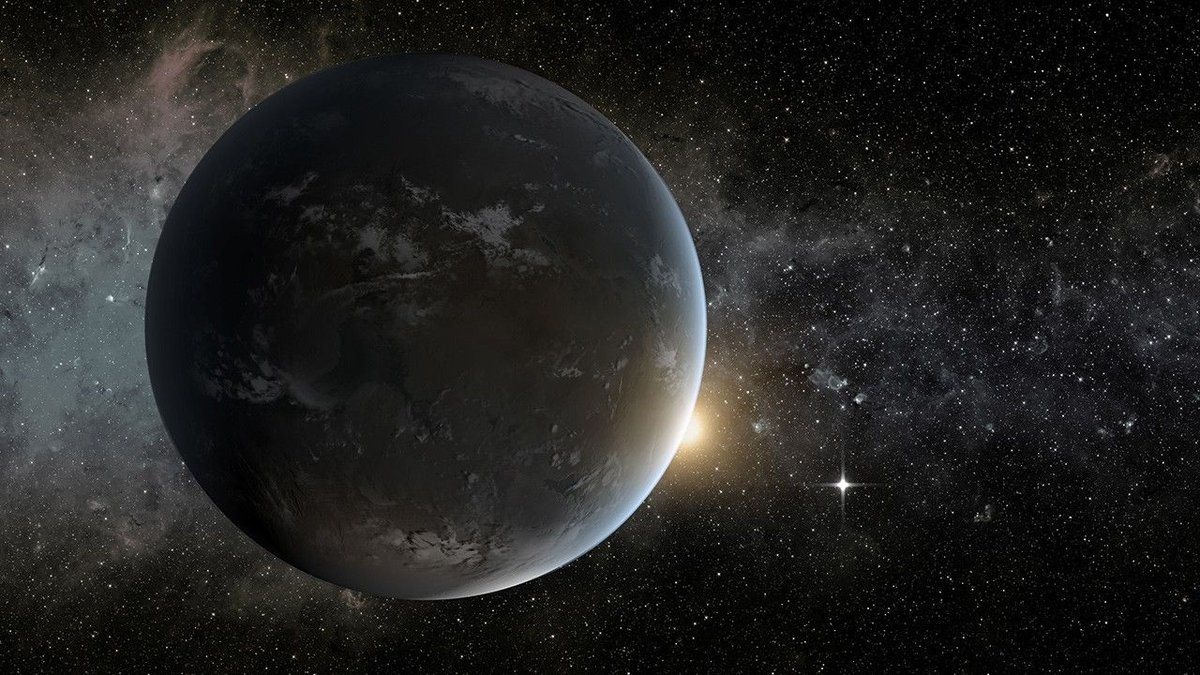
A NASA artist's concept of a super-Earth — a rocky planet larger and more massive than our own. L 98-59 d is 1.64 times Earth's mass and 1.63 times its radius. Credit: NASA/JPL-Caltech.
How the Magma Ocean Stays Molten
Here is the scientific puzzle: a planet this close to its star should be losing its atmosphere rapidly, driven off by intense stellar radiation. But L 98-59 d has managed to hold onto an atmosphere — a thick, sulphurous one. How?
The answer, the Oxford team discovered, is a feedback loop between the planet's molten interior and its atmosphere. When rock melts at these extreme temperatures, it releases sulphur. That sulphur rises into the atmosphere as hydrogen sulphide (H₂S) and sulphur dioxide (SO₂) — the same compounds that give rotten eggs and volcanic vents their distinctive smell.
But here is where it gets clever: those sulphur compounds in the atmosphere act as a chemical blanket, trapping heat and dramatically slowing the rate at which the atmosphere can escape to space. The magma produces the atmosphere; the atmosphere protects the magma. The two systems reinforce each other in a stable — if hellish — equilibrium.
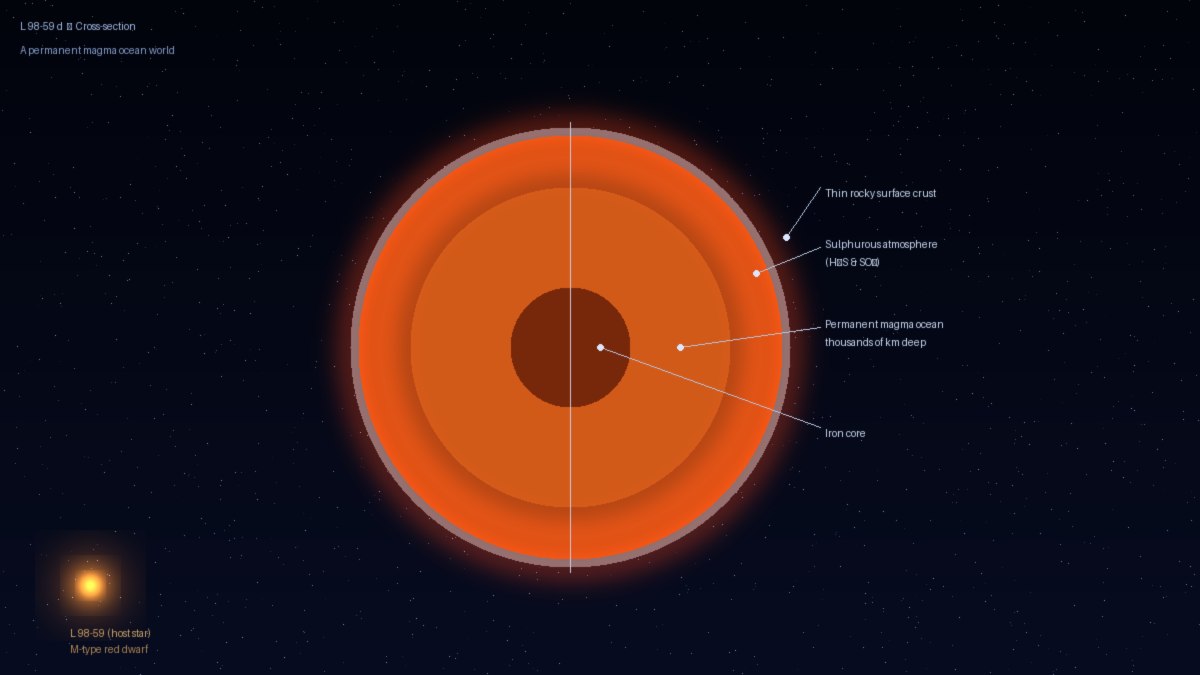
Cross-section of L 98-59 d. An iron core sits at the centre, surrounded by a permanent magma ocean thousands of kilometres deep, topped by a sulphurous atmosphere that keeps the whole system stable. Illustration: WatchTheStars.co.uk.
The magma ocean itself is not a shallow puddle. JWST's data, combined with interior modelling, suggests it extends thousands of kilometres deep — filling most of the planet's volume in molten silicate rock. The surface, if you could call it that, is a continuously churning, glowing sea of liquid stone.
What JWST Actually Detected
JWST detected the composition of L 98-59 d's atmosphere using a technique called transmission spectroscopy. When the planet passes in front of its star, a tiny fraction of starlight filters through the planet's atmosphere. Different molecules absorb different wavelengths of infrared light, leaving distinctive "dips" in the spectrum — a chemical fingerprint.
JWST's NIRSpec and MIRI instruments are sensitive enough to read those fingerprints from 35 light-years away. The clear spectral signatures of hydrogen sulphide and sulphur dioxide in the data were the first direct evidence of a magma ocean world's atmospheric chemistry. Previous telescopes simply were not powerful enough to detect it.
Co-author Professor Raymond Pierrehumbert of Oxford described the finding as "one of the most important uses of transmission spectroscopy since the technique was developed." Researchers from the University of Groningen, the University of Leeds, and ETH Zurich were also part of the collaboration.
A New Planetary Class
What makes this discovery so significant is not just what L 98-59 d is — it is what it represents. Before this study, planetary scientists understood rocky planets in three broad categories: temperate worlds like Earth, cold barren worlds like Mars, and hot bare rocks that had lost their atmospheres. L 98-59 d belongs to none of those.
It is the first confirmed member of a fourth category: sulphurous magma ocean worlds — hot, close-orbiting rocky planets that maintain stable atmospheres through the geochemical outgassing of their own interiors. Dr Nicholls believes there are likely many more of them waiting to be found. The universe may be full of these sulphurous, glowing worlds, and we simply had no way to see them before JWST arrived.
This also has implications for the early Solar System. Venus, in its early history, may have passed through a magma ocean phase similar to L 98-59 d before it evolved into the bone-dry furnace we see today. Studying L 98-59 d gives planetary scientists a live laboratory for that process.
Why It Matters
For the search for life, the immediate answer is: L 98-59 d is not habitable. The surface temperature is thousands of degrees, the atmosphere is toxic, and there is no water. But that is not why this discovery matters.
It matters because it closes a gap in our models of planetary evolution. We now know that rocky planets in close orbits around red dwarf stars — by far the most common type of star in the galaxy — can maintain atmospheres in ways we did not previously predict. That changes how we assess the potential for other planets in similar systems.
The L 98-59 system also contains two other planets — L 98-59 b and L 98-59 c — orbiting even closer to the star. Those planets may have already lost their atmospheres, stripped bare by stellar radiation. L 98-59 d, sitting slightly further out, found a way to survive. Understanding why is directly relevant to identifying which rocky exoplanets in future surveys might be genuine candidates for habitability — and which are geological wonders in their own right.
JWST was built to answer questions like this. It is doing exactly that.
🔭 Also in exoplanet news: Read our feature on 3I/ATLAS — the interstellar comet carrying chemistry from another star system →