Constellation Guide
Cassiopeia
The W-Shaped Queen of the Autumn Sky
The W-Shaped Queen of the Autumn Sky
Cassiopeia is one of the most recognisable constellations in the northern sky — its five brightest stars form an unmistakable W (or M) shape straddling the Milky Way. Circumpolar from the UK, it wheels around Polaris year-round, but blazes highest in the autumn evening sky. A rich hunting ground for clusters and nebulae, it was also home to Tycho Brahe's famous supernova of 1572 and many of Caroline Herschel's greatest discoveries.
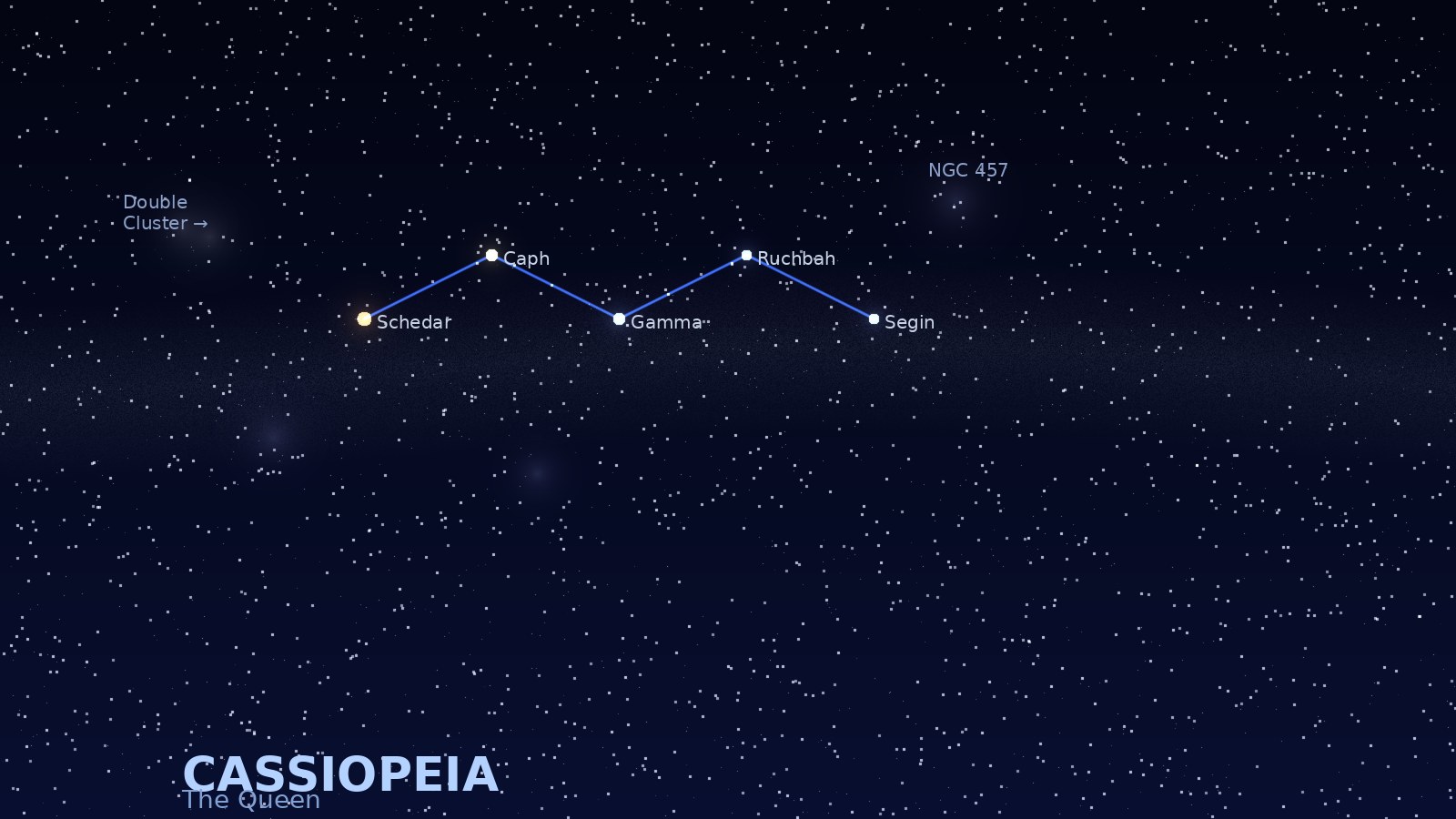
Cassiopeia is among the easiest constellations to find — its W (or M) shape is unmistakable on any clear night from the UK. Because it is circumpolar, it never sets below the horizon from Britain, though its altitude changes dramatically through the year.
Look for five medium-bright stars arranged in a clear zigzag W pattern. In autumn evenings it appears as a W high overhead; in spring it may be lower as an M. Either way the shape is unmistakable.
Find Polaris (the North Star) first, using the Plough's pointer stars. Then look in the opposite direction from Polaris — roughly the same angular distance. Cassiopeia sits directly opposite the Plough on the other side of Polaris.
Cassiopeia straddles one of the richest sections of the Milky Way. On dark nights, just tracing the pale band of the galaxy will lead you straight to the W — the stars sit right in it.
From the UK, Cassiopeia is always above the horizon, but it climbs highest in the sky during October and November evenings, when it passes near the zenith (directly overhead). It sits low to the north in spring evenings.
| Season | Evening Position | Altitude | Conditions |
|---|---|---|---|
| Autumn (Sep–Nov) | High overhead, near zenith | 65–80° | ⭐ Best |
| Winter (Dec–Feb) | NW sky, still high | 50–65° | ✅ Excellent |
| Spring (Mar–May) | Low north, M-shape | 20–35° | 👍 Good |
| Summer (Jun–Aug) | NE sky, rising again | 25–45° | 👍 Good |
The five stars of the W are all second- to third-magnitude — bright enough to see easily from suburban skies. Each has its own interesting story.
The brightest star in Cassiopeia and its orange anchor at the bottom-left of the W. Schedar is an aging giant about 45 times wider than the Sun, with a warm orange-gold colour visible to the naked eye. Its name comes from the Arabic for "breast" (of the queen).
Nearly as bright as Schedar, Caph sits at the upper-left tip of the W. It is a Delta Scuti variable — pulsating slightly over a 2.5-hour period. Remarkably close to us at just 54 light-years, it is one of the brightest stars in the sky that lies on the ecliptic's path. "Caph" means "hand" in Arabic.
The central star of the W — and the most remarkable. Gamma Cas is an eruptive Be star: it spins so fast it flings material into an equatorial disc, causing dramatic brightness changes. It has ranged from magnitude 1.6 (outshining everything nearby) to 3.0. It also emits soft X-rays at levels unusual for a normal star, still not fully explained.
Ruchbah marks the fourth point of the W. It is an eclipsing binary — a second star passes in front of it every 759 days, causing a subtle dip in brightness. "Ruchbah" comes from the Arabic for "knee." At 99 light-years it is relatively nearby.
The rightmost tip of the W. A hot blue-white giant roughly 6 times the mass of the Sun. Segin is a member of the Cassiopeia–Taurus stellar association — a loose group of stars born from the same molecular cloud. Its name has uncertain origins, possibly from a misreading of historical star charts.
In November 1572, Danish astronomer Tycho Brahe witnessed a new star appear in Cassiopeia — brighter than Venus, visible in daylight. SN 1572 shook the Aristotelian view that the heavens were unchanging. Today, the Chandra X-ray Observatory can still image the expanding supernova remnant, now about 20 light-years across.
Cassiopeia is one of the most storied constellations in the sky — a queen whose vanity led to divine punishment, her legend intertwined with Perseus, Andromeda, and Cetus across the autumn sky.
Cassiopeia was the queen of Ethiopia (Aethiopia), wife of King Cepheus, and mother of Andromeda. Her fatal flaw was hubris — she boasted that she and her daughter were more beautiful than the Nereids, the sea-nymphs of Poseidon. Enraged, Poseidon sent the sea monster Cetus to ravage the coast. An oracle told Cepheus that only the sacrifice of Andromeda would appease the gods. She was chained to a sea cliff — but Perseus, riding the winged horse Pegasus and carrying the severed head of Medusa, arrived in time to slay the creature and rescue her.
As punishment for her vanity, Cassiopeia was placed in the sky — but condemned to circle the celestial pole for eternity. For half of each night she hangs upside-down, unable to rest. This explains why she is circumpolar: she can never set, never find peace.
In the 18th century, astronomer Caroline Herschel swept the Cassiopeia region with small telescopes and discovered numerous star clusters and nebulae. NGC 7789 — a gorgeous open cluster of over 1,000 stars — is popularly known as Caroline's Rose in her honour. She was the first woman to discover a comet and to be paid as a professional scientist by the British government.
Queen of Ethiopia, mother of Andromeda. Placed in the sky by Poseidon as eternal punishment for vanity. Part of the Perseus myth-cluster spanning Cassiopeia, Cepheus, Andromeda, Perseus, and Cetus.
The constellation's Greek name preserved the ancient identity of "Aethiopia" — though this was a broad term for regions south of Egypt. Some historians see a link to actual African sky traditions in the region of the Nile's upper reaches.
In Welsh tradition, the five stars of Cassiopeia were sometimes called Llys Dôn — the Court of Dôn, the mother goddess of Welsh mythology. This Celtic interpretation gives the stars a distinctly matriarchal framing.
Chinese astronomers divided Cassiopeia between several lunar mansions. The brightest stars formed Wang Liang (王良) — a legendary charioteer, often depicted with a whip — and Ce (策), his whip itself.
For some Plains peoples, the stars of Cassiopeia were part of a hand constellation. Others saw in this region of the sky a camp of the dead, a star village on the banks of the Milky Way's great river.
Cassiopeia lies in the Milky Way's plane, making it one of the richest regions for open clusters. It also hosts striking nebulae and one of the finest globular clusters reachable from northern skies.
One of the most charming clusters in the sky. Two bright "eye" stars (Phi and HD 7902) flank a body of fainter stars extending outward like arms, giving it an uncanny resemblance to E.T. the Extra-Terrestrial — or an owl with outstretched wings. Binoculars reveal 20+ members; a small telescope shows over 100. Look about 1° south-southwest of Ruchbah (δ).
A compact, rich cluster of around 200 stars, located in the northwestern corner of Cassiopeia near the border with Cepheus. Binoculars show a fuzzy patch; a 10cm telescope resolves a tight swarm with a brighter star on the southern edge. Discovered by Charles Messier in 1774.
Discovered by Caroline Herschel in 1783, this magnificent old open cluster contains over 1,000 stars in a rich 25' field. Under a dark sky with a 15cm telescope, the interlacing curving star-chains create a rose-like pattern. An old cluster at ~1.6 billion years, most of its massive stars have already evolved away. One of the finest clusters in the northern sky.
A compact fan-shaped cluster near Ruchbah. Messier himself did not discover it — Pierre Méchain brought it to his attention, making M103 the last entry Messier himself added to his catalogue. Small but distinctive, with a red giant at its centre visible in 10cm telescopes.
A vast cloud of glowing hydrogen gas spanning nearly 200 light-years, shaped by stellar winds into a heart-like form. The nebula is triggered by the open cluster Melotte 15 at its core. Visually it is extremely faint — only detectable as a very faint glow in large apertures under pristine skies. In hydrogen-alpha photography, it is one of the most spectacular nebulae in the sky.
Technically located just over the border in Perseus, the Double Cluster is best found by sweeping from Cassiopeia's W toward Perseus. Two adjacent rich clusters of young hot stars separated by just 100 light-years — a genuine physical pair, both about 13 million years old. Naked-eye visible as a fuzzy double smudge; breathtaking in binoculars or a rich-field telescope.
Cassiopeia is a perfect starting constellation — bright, distinctive, and circumpolar from the UK. Here is a step-by-step first-night plan:
W shape, Milky Way band
M52, NGC 457, M103, star fields
Caroline's Rose, star clusters
Faint cluster detail, Heart Nebula OIII
Heart & Soul Nebulae (H-alpha)
Oct–Nov, 9–11pm
Monitor the brightness of gamma (γ) Cassiopeiae over months. This eruptive Be star can change by a full magnitude. Compare it nightly to Schedar (2.24) and Caph (2.27) — when gamma brightens near 1.6, it clearly outshines both.
Under dark skies with 150mm+, look for the curving star-chains that give this cluster its rose-like appearance. Over 1,000 stars populate a 25' field. Try at 60× to 100×. One of the most rewarding clusters in the northern sky for medium aperture.
IC 1805 is virtually invisible visually but transforms in narrow-band photography. With a DSLR and H-alpha filter, even a modest 200mm telephoto lens captures the full heart shape. Pair it with the adjacent Soul Nebula (IC 1848) for a classic two-panel mosaic.
SN 1572's expanding shell is now a radio and X-ray source. While not visually detectable, you can pinpoint its position (just northwest of Kappa Cas) as a historical exercise — then pull up Chandra or ROSAT archival X-ray images of what you are looking toward.