Key Takeaways
- Home to Olympus Mons, the tallest mountain in the solar system at 27km high
- Has seasons similar to Earth due to a comparable axial tilt
- One Martian year equals nearly 2 Earth years (687 Earth days)
Table of Contents
Mars: The 4th Planet from the Sun
Mars is the 4th planet from the Sun. It is named after the Roman god of war, most likely because of its red appearance. Although Mars is just one fifth of the size of the Earth, it has many things in common.
Mars has seasons very similar to Earth - it has a spring, summer, autumn and a winter. This is due to the rotational tilt of the planet being nearly the same as Earth's. Because Mars is further from the Sun than the Earth, it takes longer to orbit around it. In fact, Mars takes nearly twice as long to orbit the Sun as the Earth does. Because of this, 1 year on Mars is the equivalent to nearly 2 years on Earth (687 Earth days).
Main Features on Mars
Olympus Mons
Mars is home to the biggest known mountain in the solar system. Olympus Mons stands about 27km (16.77 miles) high! This is about 3 times as high as Mount Everest which stands at 8.8km (5.47 miles).
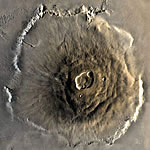
Olympus Mons, the largest mountain in the solar system at 27km high
Valles Marineris
The Valles Marineris was named after the Mariner 9 Mars orbiter which discovered it in 1971/72. Valles Marineris is a canyon that is over 4000km (2480 miles) long and more than 200km (124 miles) wide. That makes this canyon the biggest known canyon in the solar system.
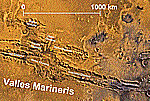
Valles Marineris - the largest canyon in the solar system at over 4000km long
How to Find Mars with Your Telescope
Mars follows a very similar orbit around the Sun to the Earth but takes nearly twice as long to complete. This is because Earth orbits closer to the Sun than Mars so it has less distance to cover to complete a full orbit (Earth has the inside track).
The best time to view Mars is when it is at opposition. This occurs every two years when the Earth is positioned directly between the Sun and Mars.
Dates of Mars Opposition
| Date | Distance from Earth | Magnitude |
|---|---|---|
| August 28th 2003 | 34.6 Million Miles | -2.88 |
| November 7th 2005 | 43.1 Million Miles | -2.33 |
| December 24th 2007 | 54.7 Million Miles | -1.64 |
| January 29th 2010 | 61.7 Million Miles | -1.28 |
| March 3rd 2012 | 62.6 Million Miles | -1.23 |
| April 8th 2014 | 57.4 Million Miles | -1.48 |
| May 22nd 2016 | 46.7 Million Miles | -2.06 |
| July 27th 2018 | 35.7 Million Miles | -2.78 |
| October 13th 2020 | 38.5 Million Miles | -2.62 |
Notice that the Earth has a much tighter orbit around the Sun than Mars does. The best viewing opportunities occur every two years when Mars is at opposition, providing the clearest and brightest views of the Red Planet.
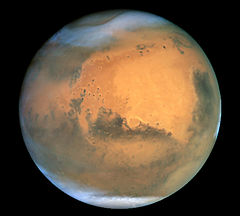
A stunning view of Mars captured by the Hubble Space Telescope