Key Takeaways
- Pluto is a dwarf planet in the Kuiper Belt, reclassified from 'planet' in 2006 by the IAU
- Has a distinctive heart-shaped nitrogen ice plain called Tombaugh Regio, over 1,000 km across
- The New Horizons spacecraft flew past Pluto on 14 July 2015 — the first close-up images ever taken
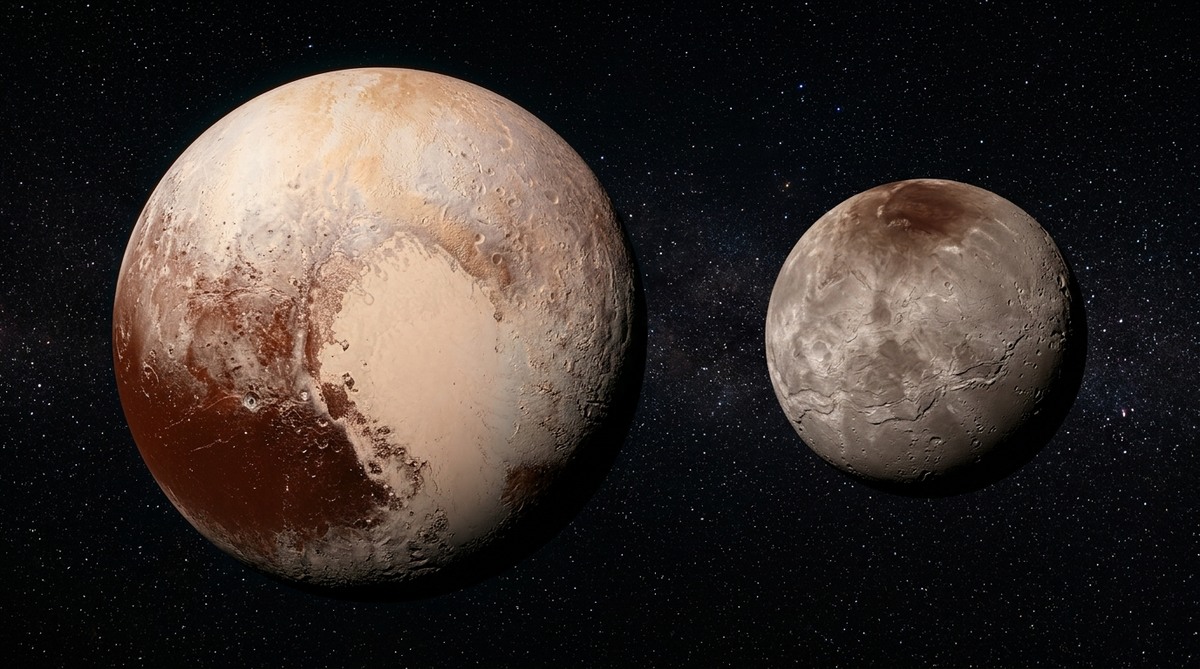
- Has 5 known moons; its largest, Charon, is so big the two bodies orbit a shared centre of gravity
- A Pluto year is 248 Earth years — it has not completed a single orbit since its discovery in 1930
Table of Contents
Discovery and the Great Planet Debate
Pluto was discovered on 18 February 1930 by 24-year-old astronomer Clyde Tombaugh at the Lowell Observatory in Flagstaff, Arizona. He found it by comparing photographic plates taken days apart, spotting a tiny dot that had moved against the background stars — the telltale sign of a nearby solar system body. It was the first object discovered in what we now call the Kuiper Belt.
The name "Pluto" was suggested by Venetia Burney, an 11-year-old schoolgirl from Oxford, England, who proposed the name of the Roman god of the underworld to her grandfather, a retired Bodleian librarian. He forwarded it to the observatory, and it was adopted unanimously. Venetia lived to see New Horizons fly past the world she named — she died in 2009, six years before the flyby, but was interviewed about her suggestion as recently as 2006.
Pluto was considered the ninth planet for 76 years. In August 2006, the International Astronomical Union voted to reclassify it as a "dwarf planet," creating a new category that also includes Eris, Makemake, Haumea, and Ceres. The decision remains controversial among planetary scientists — some argue the IAU definition is flawed and that Pluto deserves its planet status back.
A World at the Edge of the Solar System
Pluto orbits in the Kuiper Belt — a vast ring of icy objects beyond Neptune, stretching from about 30 to 50 AU from the Sun. At an average distance of 39.5 AU, sunlight takes more than five hours to reach Pluto's surface. From Pluto, the Sun appears as just an extraordinarily bright star — roughly 900 times brighter than a full Moon, but still a tiny point rather than the disc we see from Earth.
The surface temperature on Pluto hovers around −230°C (−382°F) — just 40 degrees above absolute zero. Despite this extreme cold, Pluto is not a geologically dead world. Its surface shows mountains of water ice reaching 3,500 metres high, vast nitrogen ice plains, possible cryovolcanoes, and a surprisingly complex atmosphere of nitrogen with traces of methane and carbon monoxide that expands as Pluto approaches the Sun and collapses back to frost as it retreats.
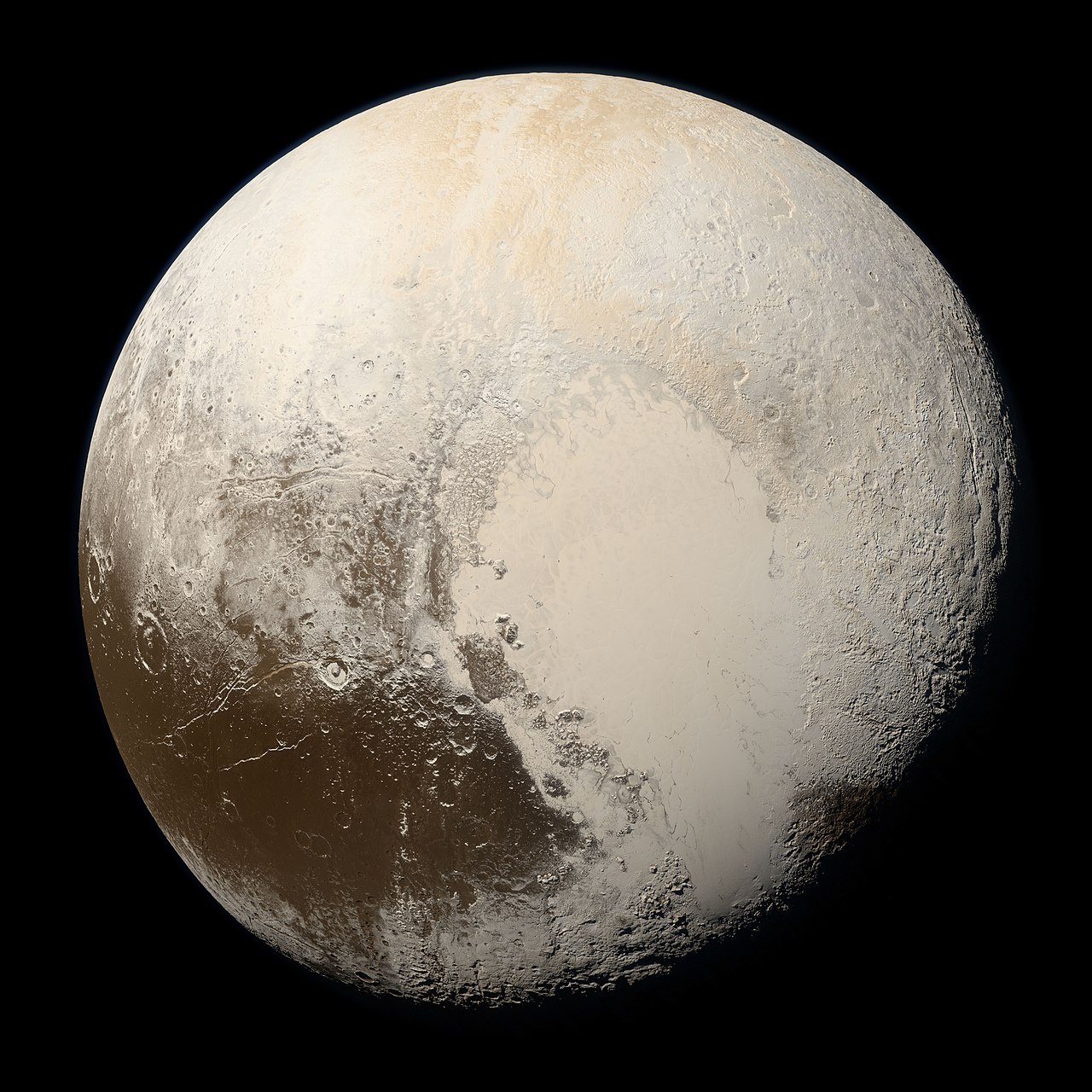
The Heart of Pluto: Tombaugh Regio
The most iconic feature on Pluto is the enormous bright heart-shaped region covering more than 1,800 kilometres across its surface. Named Tombaugh Regio in honour of Pluto's discoverer, it consists of two distinct regions: the left lobe, Sputnik Planitia, is a vast flat plain of nitrogen, methane, and carbon monoxide ice — one of the smoothest surfaces in the solar system. The right lobe is more rugged, covered in a mix of ices and highlands.
Sputnik Planitia is thought to be geologically very young — perhaps only 500 million years old, a blink of an eye in planetary terms. Scientists believe the nitrogen ice is slowly convecting, with warm blobs rising from below and cool material sinking, similar to a lava lamp. This convection erases craters over time, explaining the plain's remarkable smoothness. The boundary between Sputnik Planitia and the surrounding darker terrain features dramatic mountain ranges of water ice reaching up to 3.5 km high.
The dark reddish terrain elsewhere on Pluto's surface is rich in tholins — complex organic molecules formed when methane and nitrogen in Pluto's thin atmosphere are bombarded by solar ultraviolet radiation and cosmic rays. Tholins are considered a building block of prebiotic chemistry and are found throughout the outer solar system.
The giant Sputnik Planitia basin is thought to have formed from a massive impact billions of years ago. The extra mass of the nitrogen ice filling the basin slowly reoriented Pluto's rotation so the basin now faces directly away from Charon — a process called true polar wander. Pluto's heart is effectively pointing at its moon.
New Horizons: Seeing Pluto for the First Time
For 85 years after its discovery, Pluto was little more than a fuzzy smudge in even the world's most powerful telescopes. That changed forever on 14 July 2015, when NASA's New Horizons spacecraft swept past Pluto at 49,600 km/h, passing just 12,500 km from the surface — closer than the distance from London to Sydney.
New Horizons was launched in January 2006 — the same year Pluto was demoted — and spent nine and a half years crossing the solar system. At its closest approach it gathered as much scientific data as it could in a single brief encounter, then spent the next 15 months transmitting it back to Earth at a glacially slow rate across 4.8 billion kilometres of space.
The images that came back astonished planetary scientists. Instead of the barren, cratered rock they had expected, New Horizons revealed a diverse, active world — towering mountain ranges, smooth nitrogen ice plains, hazes in the atmosphere reaching 200 km above the surface, and evidence of possible cryovolcanoes. Pluto was alive in ways nobody had anticipated.
Charon and the Five Moons
Pluto has five known moons: Charon, Styx, Nix, Kerberos, and Hydra. Charon, discovered in 1978, is extraordinary among moons of the solar system — at roughly 1,212 km in diameter, it is more than half the size of Pluto itself. This makes the Pluto-Charon system unique: rather than Charon orbiting Pluto, both bodies orbit a shared centre of gravity (a barycentre) that sits in empty space between them, about 19,600 km above Pluto's surface.
Because of this mutual orbit, Pluto and Charon are tidally locked — they always show the same face to each other, much like how our Moon always shows the same face to Earth. If you stood on Pluto facing Charon, the moon would appear to hang motionless in the sky, roughly seven times larger than our Full Moon appears from Earth.
The four smaller moons — Styx, Nix, Kerberos, and Hydra — are tiny, irregular, and chaotically tumbling. New Horizons revealed that Nix appears reddish and may be coated in the same tholins found on Pluto, while Hydra is surprisingly bright and reflective. All four are thought to have formed from the same giant impact that created Charon billions of years ago.
Pluto's Five Moons
Styx — ~16 km diameter. Discovered 2012 by Hubble. Irregular, tumbling orbit. Possibly a captured fragment from the Charon-forming impact.
Kerberos — ~19 km diameter. Discovered 2011 by Hubble. Surprisingly dark for an outer solar system body.
Hydra — ~65 km diameter. Discovered 2005 by Hubble. Unusually bright, highly reflective water ice surface.
Can You See Pluto?
Pluto can technically be seen with a telescope, but it is extremely challenging even for experienced amateur astronomers. It currently shines at about magnitude 14.4 — far below the naked-eye limit (around magnitude 6) and requiring a telescope of at least 200–250mm aperture under very dark skies, plus precise star charts to identify it against the dense star fields of Sagittarius where it currently sits.
Even then, you will not see a disc. Pluto appears as nothing more than a faint star-like point. The way to confirm you've found it is to observe the same field over two or three consecutive nights and identify the one "star" that has moved slightly against the fixed background. It is the same method Clyde Tombaugh used to discover it in 1930.
Pluto reached opposition (its closest approach to Earth each year) in late July 2025, when it was best placed for observation. It will reach opposition again in August 2026 and remains in Sagittarius for several more years. For UK observers, Pluto never rises very high above the southern horizon — it sits in a part of the sky that is challenging to observe from northern latitudes.
You will need: a telescope of at least 200mm (8") aperture; a very dark sky site (Bortle class 4 or better); accurate star charts from Sky & Telescope or Stellarium; patience over multiple nights to detect movement. Even then, it remains one of the most challenging targets in backyard astronomy.