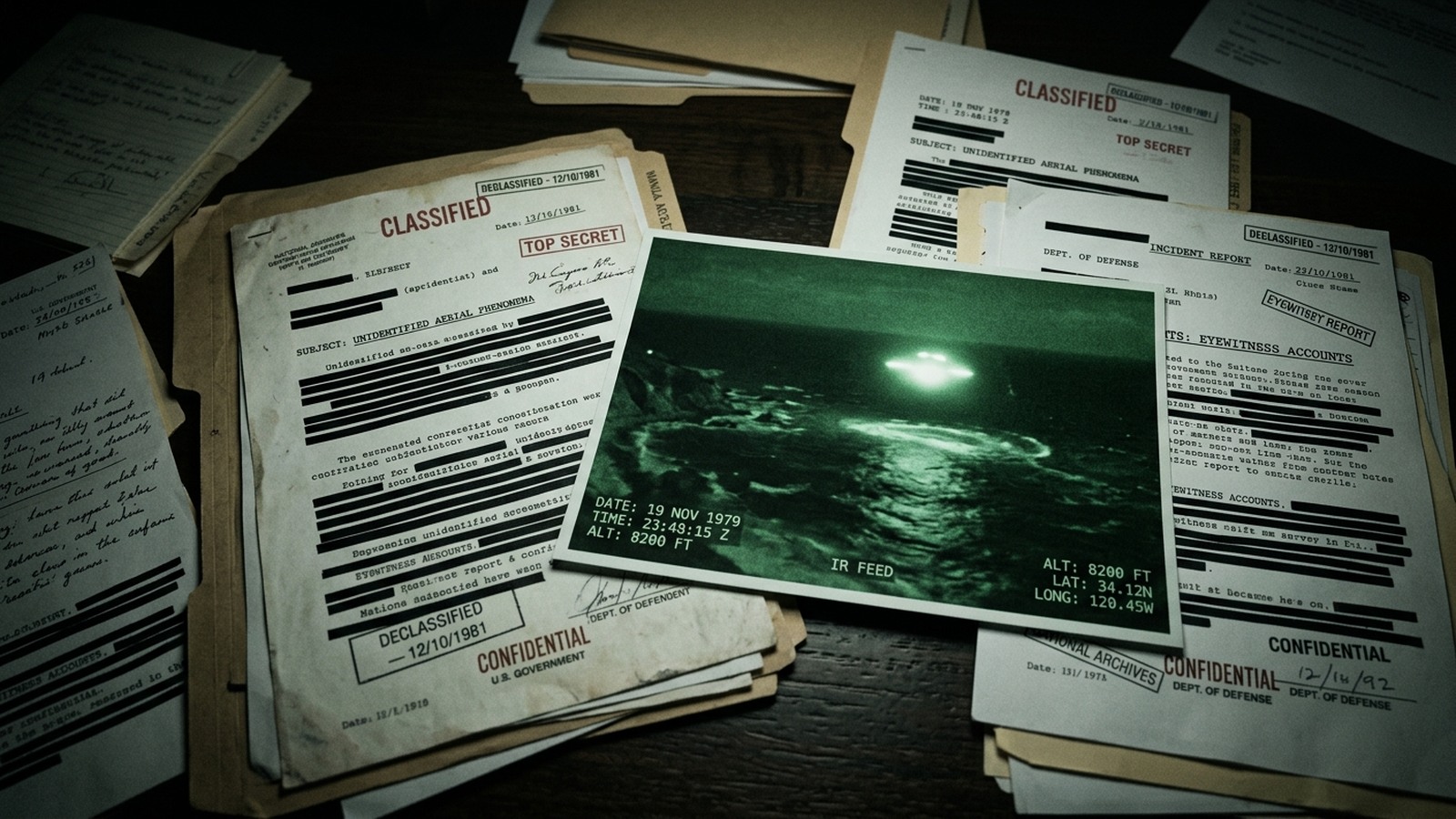
Key Takeaways
- 57 MP4 videos were released alongside the May 2026 PURSUE document bundle — the DoD pre-flagged 11 as 'Interesting'
- We reviewed all 11 flagged clips honestly: most show clouds, terrain, open ocean, or identifiable objects like vessels
- Three clips stand out as genuinely difficult to explain: a close-up infrared object on the ocean surface, a multi-object NVG cluster, and a 17-second ground-level airfield sighting
- Harvard astrophysicist Avi Loeb described the release as 'a mixed bag' — many cases have simple explanations
- All telemetry — dates, coordinates, platform identity — is redacted across every clip
📑 Table of Contents
Buried inside the government's second PURSUE release on 22 May 2026 — alongside six PDFs of declassified documents — were 57 MP4 video files. 5.6 gigabytes of military sensor footage, every clip stripped of dates, coordinates and platform identity.
The DoD helpfully flagged 11 of them as "Interesting" in the filename. So we watched all 11.
Most aren't interesting. Clouds, open ocean, a ship, desert terrain. Harvard astrophysicist Avi Loeb reviewed the same release and said it plainly: "It's a mixed bag. Many of these objects are indeed simple to understand."
Three of the clips are a different story.
What Was Released — and How to Read the Sensor Footage
The clips come from at least six different sensor types. A quick guide to the main ones you'll encounter:
FLIR (Forward Looking Infrared) — a thermal camera that detects heat. Warm objects show up bright white. Standard kit on military aircraft for tracking vessels and aircraft in the dark.
NVG (Night Vision Goggles) — amplifies low ambient light into a viewable image. Gives that distinctive grainy, high-contrast black-and-white look. The black rectangles you'll sometimes see around the edge of the image are where the goggle aperture cuts off.
EO (Electro-Optical) — basically a standard camera, sometimes colour, sometimes black and white. What you'd recognise as conventional video footage.
HUD (Heads-Up Display) — the targeting crosshair, compass markers, and other readouts overlaid on the sensor image by the aircraft's systems.
That mix of sensor types suggests the clips were pulled from different units and incidents rather than one continuous event. One clip isn't aerial footage at all — it looks like it was filmed from the ground with a standard camera.
Every single clip has its telemetry blacked out. No dates, no locations, no platform information. We have no idea when or where any of this was recorded.
Clip 1: An Angular Object on the Ocean Surface
Clip 111719800 | 10 min 48 sec | Sensor: NVG/infrared
Of all 57 clips, this one gives you the clearest look at an actual object. For most of its ten minutes it's just dark ocean with a sensor tracking something in the distance. Then it closes in.
What you're looking at — about halfway through — is a bright white shape with a jagged, irregular outline. It's not a reflection off a wave. It's not a smear of light. It has edges, and those edges are angular and uneven. There's a dark shadow-like void at the bottom of it. In infrared, bright means warm — and whatever this is, it's considerably warmer than the water around it.
Could it be a boat? Maybe. But ships tracked on military thermal sensors usually show up as an elongated hull shape, and this doesn't look like that. And someone kept a camera locked on it for ten minutes, which suggests they weren't sure what they were looking at either.
Clip 111719800 — extract from a 10-minute infrared tracking sequence. The angular object is visible throughout; the sensor zooms in progressively. Source: US Department of War PURSUE release, May 2026. Public domain.
Clip 2: Multiple Objects in NVG Footage
Clip 111719833 | 17 min 36 sec | Sensor: NVG — most heavily redacted clip in the set
This is the longest clip in the release at 17 minutes, and also the most redacted — more blacked-out boxes than anything else in the set. For most of it you're watching empty ocean. Nothing at the crosshair.
Then, about 13 minutes in, the sensor pans upward toward a cloudy night sky. And sitting near the crosshair are 2-3 small, distinctly bright points of light. Not one blob — separate objects, clustered together, holding their position relative to each other as the clouds shift around them.
Aircraft? Possibly. Stars through a gap in the clouds? Less likely given where the crosshair is pointing. We can't say what they are. What we can say is that out of 57 clips in this release, this one got the most redaction — which at least tells you someone thought there was something worth hiding.
Clip 111719833 — extract from a 17-minute NVG sequence. This extract covers the portion where the objects become visible. The full video is available at war.gov/ufo. Source: US Department of War PURSUE release, May 2026. Public domain.
Clip 3: A Ground-Level Sighting at an Airfield
Clip 111720752 | 17 seconds | No military sensor — standard camera
Every other clip in this set is aerial military sensor footage. This one isn't. It was filmed from the ground, with what looks like a standard camera — no crosshair, no HUD, no sensor markings of any kind.
You're looking at a dark flat surface — tarmac or concrete, so probably an airfield or base. There are small red and white lights along the horizon, the kind you'd see from aircraft or runway markers. A large cloud on the horizon is glowing from below.
Then, around the 12-second mark, a small bright oval object appears just above the horizon on the left side of the frame. It's noticeably brighter than everything else in shot. The shape is clean and rounded — nothing like the cloud around it.
Seventeen seconds. That's all there is. No explanation, no context, no follow-up frame.
Clip 111720752 — 17 seconds. Watch the horizon at the 12–14 second mark. Source: US Department of War PURSUE release, May 2026. Public domain.
The Other Eight Clips
Here's what the other eight actually show:
111719741 — a small bright dot on a FLIR ocean surface. Buoy, vessel light, or thermal artefact. Not nothing, but nothing you'd write home about.
111719752 — a crosshair pointing at clouds. No object visible at all.
111719807 — NVG looking straight down at what looks like a building complex. Rectangular structures on the ground. This is surveillance footage of an installation, not an aerial encounter.
111719828 — colour daylight footage of desert terrain shot from high altitude. There's no object in the sky. The crosshair is tracking a circular depression in the ground — possibly a crater or dry salt flat.
111720696 (the ship) — NVG over open ocean that eventually shows a clearly elongated object with a hull shape and a wake behind it. That's a boat. It was probably flagged because it appeared in a patrol area without being on the known shipping list, which is a security concern, not a UFO.
111719835 — grey atmosphere over water. There's a faint glow in the upper part of the frame but nothing you could point to as a distinct object.
111719847 — a dark smudge below the crosshair against cloud. Likely a shadow in the cloud layer or a compression artefact.
111720700 — 30 seconds of a smoke or cloud formation being tracked by an older targeting system with a circle crosshair rather than a cross. The targeting display is genuinely unusual — it suggests a different aircraft type from the others — but what it's pointing at is just a cloud.
What the 2026 PURSUE UFO Videos Actually Tell Us
Of the 11 clips the DoD flagged as "Interesting", three are actually interesting. The other eight are mostly surveillance footage, empty sky, and one fairly obvious ship.
That's not a failure of disclosure — it's just what happens when you release a large batch of unresolved sensor files. Some of them are unresolved for good reason. Some of them are unresolved because no one's had time to identify every contact that appeared on every screen.
Avi Loeb put it well when reviewing this release: "We shouldn't get excited about each and every video." The three clips that genuinely don't have an easy explanation are still worth your attention — but they're worth more attention, not less, when you're not being asked to treat clouds and ships as part of the same story.
Frequently Asked Questions
What UFO videos did the Pentagon release in May 2026? The US Department of War released 57 MP4 video files on 22 May 2026 as part of the PURSUE programme. The DoD pre-flagged 11 of those clips as "Interesting" in their filenames. The footage comes from multiple military sensor platforms including FLIR thermal cameras, NVG night-vision systems, and colour cameras. All metadata — dates, locations, platform identity — has been redacted.
Which declassified UFO video clips are worth watching? Of the 11 DoD-flagged clips, three are genuinely compelling: clip 111719800 (a 10-minute infrared tracking sequence showing an angular object on the ocean surface), clip 111719833 (a 17-minute NVG sequence where 2-3 distinct glowing objects appear clustered near the crosshair), and clip 111720752 (17 seconds of ground-level footage from what appears to be a military airfield, showing a bright oval object above the horizon). The other eight clips show clouds, terrain, a ship, or nothing at the crosshair.
What is the PURSUE programme and why were UFO videos released? PURSUE stands for Presidential Unsealing and Reporting System for UAP Encounters. It was established under a Trump executive order directing US government agencies to review and declassify UAP-related records for public release. The May 2026 video bundle was the second PURSUE release, following a larger document package on 8 May 2026.
Why do the UFO videos show nothing on most clips? The DoD flagged 11 clips as "Interesting" but that label doesn't guarantee the footage is visually dramatic. Some clips were likely included to show the full range of unresolved sensor contacts, or because the encounter was significant even if the footage isn't. Many military sensor contacts remain unidentified simply because no one has had time to cross-reference them — that's different from being genuinely anomalous.
What do FLIR and NVG mean in the UFO videos? FLIR (Forward Looking Infrared) is a thermal camera that detects heat signatures — warmer objects appear brighter. NVG (Night Vision Goggles) amplifies ambient light into a visible image, producing the characteristic grainy black-and-white look. Most of the 57 released videos were captured on one of these two sensor types.
Sources:
- US Department of War PURSUE release — Video bundle (May 22, 2026)
- Analysis of the Second Batch of UFO Files — Avi Loeb, Medium
- War.gov/UFO — Metabunk analysis thread
- Inside the Government's New UFO Files: What the 2026 Release Actually Says