Key Takeaways
- Scientists at Northwestern University confirmed wind blowing from Sagittarius A*, our galaxy's central black hole, ending a 50-year search
- The wind carved a three-light-year-long cone-shaped cavity in surrounding gas — only detectable with the world's sharpest radio images
- The wind has been active for at least 20,000 years, confirming Sgr A* behaves like other supermassive black holes — just much more quietly
- The discovery was made using five years of ALMA telescope data, confirmed by NASA's Chandra X-ray Observatory
- Sgr A* eats so little it's the cosmic equivalent of one grain of rice every million years — yet it still blows a wind
📑 Table of Contents
On 5 June 2026, astronomers announced they had finally found something that had eluded science for half a century: wind blowing from the supermassive black hole at the centre of our own galaxy.
The discovery, published in The Astrophysical Journal Letters, was made by researchers at Northwestern University using five years of observations from the ALMA radio telescope array in Chile, confirmed by NASA's Chandra X-ray Observatory. And when the data finally clicked into place, the moment of realisation was immediate.
"We looked at the data and said, 'There it is. There is the thing that everybody's been looking for for 50 years,'" said Mark Gorski, the study's co-lead author.
The Black Hole at the Heart of the Milky Way
Right at the centre of the Milky Way, about 26,000 light-years from Earth, sits Sagittarius A* (pronounced "Sagittarius A-star", often written Sgr A*). It is a supermassive black hole — roughly four million times the mass of our Sun — and it is the gravitational anchor around which our entire galaxy slowly rotates.
You've almost certainly seen it. In 2022, the Event Horizon Telescope collaboration released the first real image of Sgr A*: a fuzzy, glowing orange ring of superheated gas surrounding a dark central shadow. It was a historic photograph of something 26,000 light-years away and roughly the size of our solar system.
But that image, extraordinary as it was, couldn't show us everything. One of the longest-standing mysteries in astronomy was this: where was the wind?
Why the Wind Was So Hard to Find
Physics has long predicted that feeding black holes should blow winds. When gas and dust spiral inward toward a black hole, the material accelerates to near light-speed. This generates enormous energy and pressure — enough to fling some of the hot, fast-moving material back outward. Black hole winds aren't just theoretical; they've been detected around ravenously feeding black holes in other galaxies.
But Sgr A* is peculiar. It barely eats. Scientists describe it as consuming the cosmic equivalent of one grain of rice every million years — a near-perfect fast on a galactic scale. With so little material falling in, any outward wind would be correspondingly faint.
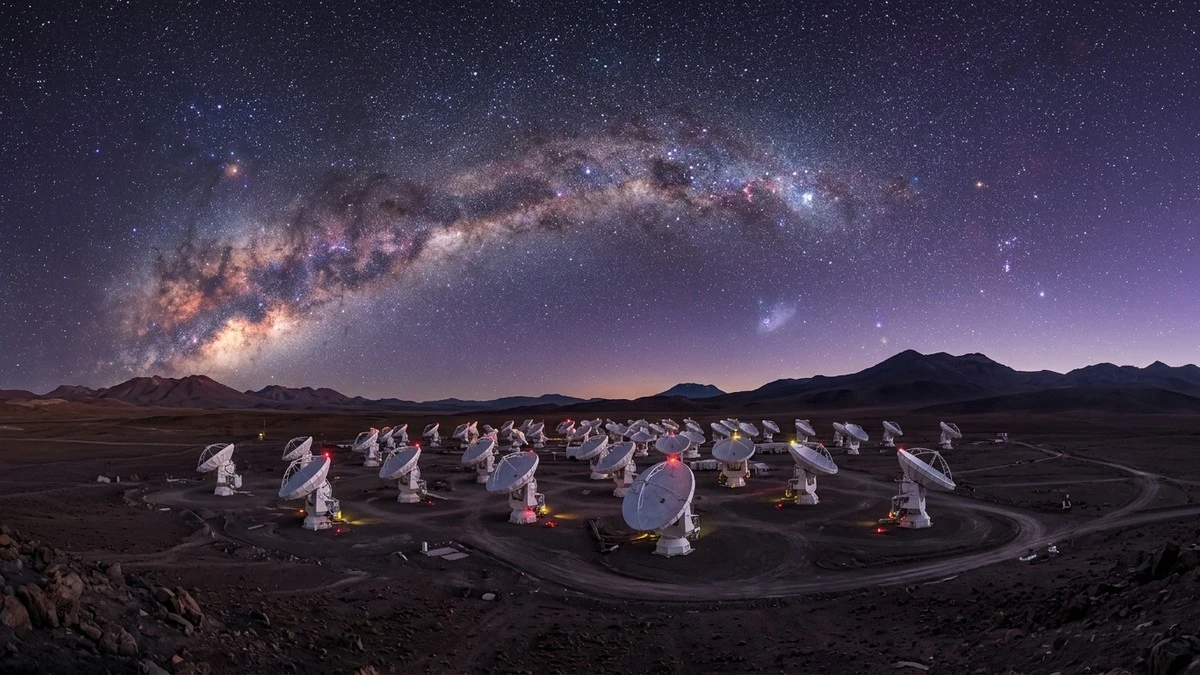
Then there's the problem of looking at it at all. To observe Sgr A*, we have to peer through the full plane of our own galaxy — 26,000 light-years of gas, dust, and swirling ionised structures that muddy any signal. It's like trying to watch a candle through a sandstorm.
"To observe our own black hole, we have to look through the plane of our galaxy," explained co-lead author Elena Murchikova, an assistant professor of physics and astronomy at Northwestern. "That means we have to peer through gas, dust and ionised structures, and you can't really see through all of that easily."
For half a century, astronomers found nothing they could confidently call a wind. That all changed when Gorski and Murchikova combined five years of deep observations from ALMA with a new calibration technique to remove the black hole's own bright radio signals from the image. The result was an image of cold molecular gas around Sgr A* that was 100 times deeper and 80 times sharper than any previous map of the region.
And in that image, something was missing.
A Hole in Space That Shouldn't Be There
Right next to Sgr A*, in a region where cold molecular gas should have been abundant, there was nothing. A vast, cone-shaped cavity — nearly one parsec (three light-years) long and 45 degrees wide — was completely devoid of cold gas. And crucially, the tip of that cone pointed directly at the black hole.
The only thing that could have carved out such a cavity was hot, energetic wind blowing outward from Sgr A* itself. As the black hole's wind expands outward, it does one of two things to the cold gas it encounters: it either sweeps it away entirely, or heats it up until it's too warm to be detected by radio telescopes.
"If you blow hot material from the black hole, it's not going to want to exist with the cold material," Gorski said. "It's either going to push the cold material out or heat it up. And, if it's too hot, you will no longer see the cold gas."
Extraordinary Claims, Extraordinary Evidence
Gorski and Murchikova were careful. Discovering a feature no one has seen in 50 years of searching demands more than a single data source.
"Exceptional claims require exceptional evidence," Gorski said. "We wanted to make sure that we weren't just looking at some sort of imaging artifact."
The team's first thought when they saw the cavity wasn't celebration. It was doubt.
"When you find something that no one has seen before, the first thought that runs through your mind is not 'Oh my god, we made a discovery,'" Murchikova recalled. "It's 'Oh my god, what's wrong with my analysis?'"
Their cross-check came from a completely independent source: NASA's Chandra X-ray Observatory, which had previously mapped bright X-ray emissions from the same region. When the team overlaid the Chandra X-ray image on their ALMA radio image, the match was perfect. The cone-shaped absence of cold gas in the radio data aligned precisely with a cone of bright hot X-ray-emitting plasma.
"Then, the X-ray image from Chandra just slotted in perfectly. The molecular features lined up," Gorski said.
They also ruled out stars as the cause. The region around Sgr A* is densely packed with young, massive stars — and massive stars blow powerful winds of their own. But the team calculated how much energy would be needed to carve a cavity of this size. The combined power of every nearby star fell short. Only the black hole itself could account for it.
"It's a huge absence of material," Gorski said. "We calculated how much energy was needed to create this cavity. It is more than can be provided by the stars in that area. Basically, there has to be input from the supermassive black hole. And, if you follow the shape of the cone, it's pointed directly at the black hole."
A Black Hole on a Cosmic Diet
One of the most striking things about Sgr A* is just how little it eats. For a human, the equivalent diet would be one grain of rice every million years. By black hole standards, it is essentially starving.
Most of what we know about supermassive black holes comes from studying so-called active galactic nuclei (AGN) — galaxies whose central black holes are consuming material at voracious rates, blazing with energy and launching jets of plasma thousands of light-years long. But AGN represent black holes caught in a frenzied, temporary state. Most supermassive black holes, for most of their lives, sit quietly — just like Sgr A*.
This matters enormously. For decades, astronomers have been able to study black holes in their "fireworks stage." But that's not the normal state of the universe.
"The majority of other galaxies spend most of their lives in a state where they are not particularly active," Murchikova said. "But we can only see them when they are in a fireworks stage. It is very attractive to study black holes when they are in the fireworks stage, but that's not actually their dominant state."
"Sgr A* finally gives us a window into the life of a black hole in this quiet state."
Based on how far the wind's effects extend into a nearby stream of ionised gas, the team estimates the wind has been active for at least 20,000 years. In cosmic terms, that makes it extremely recent — well within the timescale of modern human history.
Why This Discovery Matters
On one level, this is a pure scientific milestone — the resolution of a half-century mystery. But the implications run deeper.
The discovery confirms that Sgr A* is not a unique outlier. It produces wind, just like every other black hole that theory predicts should. Our galaxy is not strange, and our position in it is not special. The physics that governs black holes hundreds of millions of light-years away governs the one at the centre of our own Milky Way.
"The wind is not powerful, and its direction probably wanders with time. It shows that our black hole is not unique, and our place in the universe is not unique," Murchikova said.
It also opens an entirely new window into the centre of the galaxy — one that no astronomer has looked through before. The new ALMA images, 100 times deeper than anything previously achieved, will enable years of follow-up science. The cone-shaped cavity is just the beginning.
And there's something quietly wonderful about the timing. Right now, on a clear summer night, the centre of the Milky Way is almost directly overhead from the UK — a thick, glowing band of stars stretching from south to north. Every photon of that light began its journey in the direction of Sagittarius A*, the black hole that has been exhaling a 20,000-year-old cosmic breath without anyone knowing.
Now we know. And that feels like something.
Sources:
- Found: Milky Way black hole's missing wind — Northwestern Now
- Scientists find wind blowing from our Milky Way's black hole after half-century search — Space.com
- They've Been Searching for the Milky Way's Black Hole Wind for 50 Years and Finally Found It — Universe Today
- Milky Way black hole's missing wind finally found after a half-century-long search — Phys.org
- The Astrophysical Journal Letters — Original study